Anyone can build software with AI. And then?
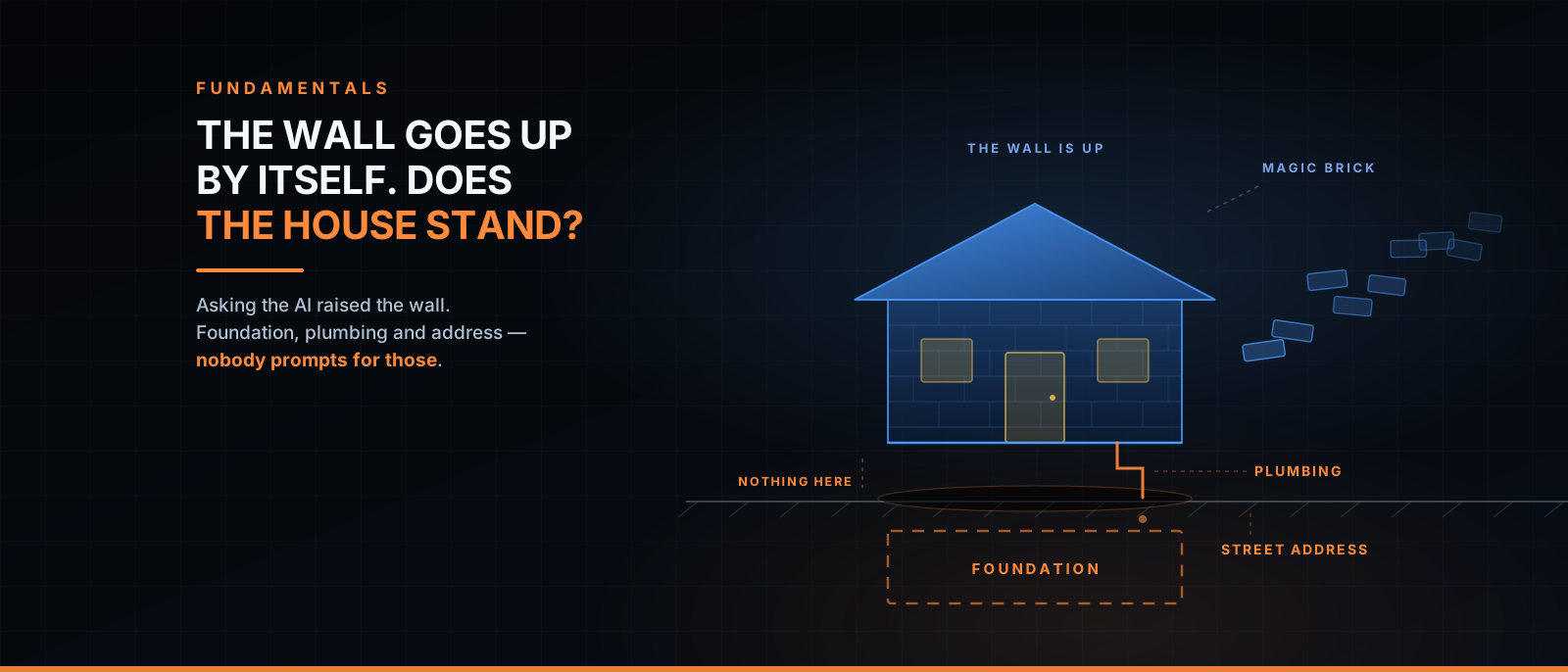
Raising the wall got cheap. What got expensive is the foundation, the plumbing and a street address — and nobody asks for those in a prompt.
You are right about the first half
When someone tells me that anyone can build their own software today — you ask, and the AI does it —, I agree with the first half of that sentence, without reservation and without defending territory.
Writing code became a utility. Last week I described an internal tool in two sentences — it reads closing spreadsheets and spits out a summary — and had it running on my screen in about forty minutes. Five years ago that would have been a whole afternoon, minimum, and I would still have to remember the syntax of a library I use three times a year.
That part is genuinely over. Whoever made a living being the person who knew how to write the right loop has a real problem.
The thing is that writing code was never the software. It was the visible part of it.
The magic brick
The image I use to explain this is a house.
Imagine someone invented a brick that shapes itself. You say "I want a wall here" and it goes up, straight, plumb, in seconds. That is exactly what happened to code: the wall got cheap.
Except nobody lives in a wall. People live in a house — and a house is the wall plus a pile of things that never show up in the photo: foundation, plumbing, wiring, a roof that does not leak, land with an address, a deed, and someone who knows where the main valve is when a pipe bursts at eleven at night.
The magic brick gave you none of that. It gave you the wall very fast, which is excellent, and left you with the impression that the house is finished, which is expensive.
What shows up three months later
The plumbing bursts. The system works with your ten test cases and breaks on case eleven, which only appeared in October because that is when an invoice with a retroactive discount comes in. The error does not arrive labeled "here is the problem"; it arrives as a wrong number in a report somebody used to make a decision. Finding where it came from is the work, and it is work that requires understanding the whole system — not just the piece you asked for.
The house is standing in the middle of the street. Running on your machine and being live are different things. Live means a server, a domain, a certificate, a database with a backup somebody has actually restored, a login that does not let user A see user B's data, dependency updates when a security flaw lands, and a bill at the end of the month that has to make sense. None of that becomes a line in a prompt, because none of it is writing code.
Nobody can open the door. The AI builds what you asked for with impressive fidelity. The problem is that what you asked for is almost never what the person needs — and that only surfaces when a real human sits in front of the screen and gets stuck on a step you thought was obvious. Discovering the right request is still a conversation with people, and it is still the hardest part.
Nobody is responsible. If the system miscalculates a tax, who answers for it? If it leaks customer data, who explains that to the authority and to the customer? Software that touches money, health or personal data carries legal responsibility — and responsibility cannot be delegated to a model.
The bill nobody puts in the prompt
Run this test on your generated project. Five questions:
- If the database dies right now, how much work do you lose? A backup that was never restored is not a backup.
- Who can see what? A login is not authorization. Most generated systems have a login screen and no check on who may see which record.
- How do you find out it broke? If the answer is "when a user complains", the system has no monitor.
- What does it cost to run at a hundred times the usage? Code that is correct and operationally naive is the signature of something finished too fast.
- Who touches this a year from now? Including you, remembering nothing, with the model already two generations along.
None of those questions is about syntax. All of them decide whether that thing is software or a demo that lasted three weeks.
What got cheap and what got expensive
Cheap now: writing, translating from one language to another, remembering an API, assembling the first version, building the prototype that proves the idea. That is a commodity, and whoever charged for it will have to charge for something else.
Expensive now: deciding what should exist, verifying that it is right, connecting it to what already exists, putting it live, keeping it standing and answering when it goes wrong. Notice that all of it is judgment and responsibility — not typing.
The professional stopped being the one who knows how to write and became the one who knows how to verify. It is a different profession with the same name.
Where "I asked and the AI did it" wins by a mile
Being honest to both sides: there is an enormous band where this whole objection does not apply, and it is a band that did not exist before.
A tool only you use. Automating your own routine. A spreadsheet that became a little screen. A prototype to show the idea before hiring anyone. An internal system for five people, with no sensitive data, whose worst case is losing an afternoon of work.
Go ahead there, without asking anyone's permission. That is the real democratization, and it is good. The mistake is believing the same ease extends to the system that will serve a thousand customers and move their money.
The ruler is the cost of the worst case. Small worst case: ask and use it. Expensive or irreversible worst case: you need engineering, with or without AI.
What to do on Monday
If you want to build your software with AI — and you should, this is the best moment in history for it:
- Pick a real problem of your own with a cheap worst case. No "I am going to build an app for the market". Build the thing that annoys you every Tuesday morning.
- Put it live for real, even if only for yourself. That is where the domain, the backup, the login and the bill appear — and where you learn what the wall does not teach.
- Run the five questions before calling it done. Write down which ones you cannot answer: that list is exactly your next study.
- Before letting another person depend on it, get someone who has put a system on its feet to look. An hour of review costs far less than the plumbing bursting in production.
AI handed you the magic brick. That is a lot. Just do not confuse the wall with the house — because whoever lives inside does not see the brick, they see whether water comes out of the tap.
Get the next articles
No spam. One message when a new article is out, with an unsubscribe link in every one.