Does prompt engineering still make sense in 2026?
The tricks died. The discipline stayed — it just changed its name and its address: now it is called context engineering.
What genuinely died
Let us bury the dead first, because people are still selling courses about them:
- "You are a world-class expert in..." Current models do not need flattery to reach competence. That burned tokens and changed nothing.
- "Take a deep breath and think step by step." It was a legitimate discovery in its day. Models now reason by default, and some have an explicit reasoning mode. The phrase became folklore.
- Threats and rewards. "I'll tip you 200 dollars", "my grandmother will die if you get this wrong". They worked marginally on old, poorly tuned models. Today they are just embarrassing.
- Packs of a thousand ready-made prompts. Sold as a product, obsolete with every model generation, useless without your context.
If your prompting knowledge is that list, it has expired.
What still holds — and holds harder
What survived is not a trick, it is precise communication. And it became more important, not less, because a prompt no longer talks only to a person: it configures a system that runs by itself a thousand times a day.
Specific context. The difference between a generic answer and a useful one is almost never in the phrasing — it is in how much of your world you put inside the request. Who the audience is, what the constraint is, what has already been tried, what output format you expect.
An example beats an instruction. Two or three examples of the right result align the model better than two paragraphs describing what you want. That has not changed since the beginning and shows no sign of changing.
Explicit success criteria. Saying how you will judge the answer improves the answer. "I prefer concise over complete", "optimise for readability, not performance", "if information is missing, ask instead of assuming".
Decomposition. A big task broken into verifiable steps. It works for the model for the same reason it works for an intern: it reduces the chance of going wrong without anyone noticing.
Permission not to know. One line — "if you have no basis to answer, say you do not know" — cuts a meaningful slice of invention. Too cheap not to use.
Where the discipline went
Here is the turn that matters: the prompt left the chat and moved into the system.
When you talk to it manually, a bad prompt costs one attempt. When the prompt lives inside an agent running in production, it is code: it defines behaviour, costs money on every execution, and breaks silently when the model changes.
That brought the engineering practices along with it:
- Versioned prompts in a repository, with change history and review.
- Automated evaluation — a set of cases with expected answers, run on every change. Without it, "it got better" is a guess.
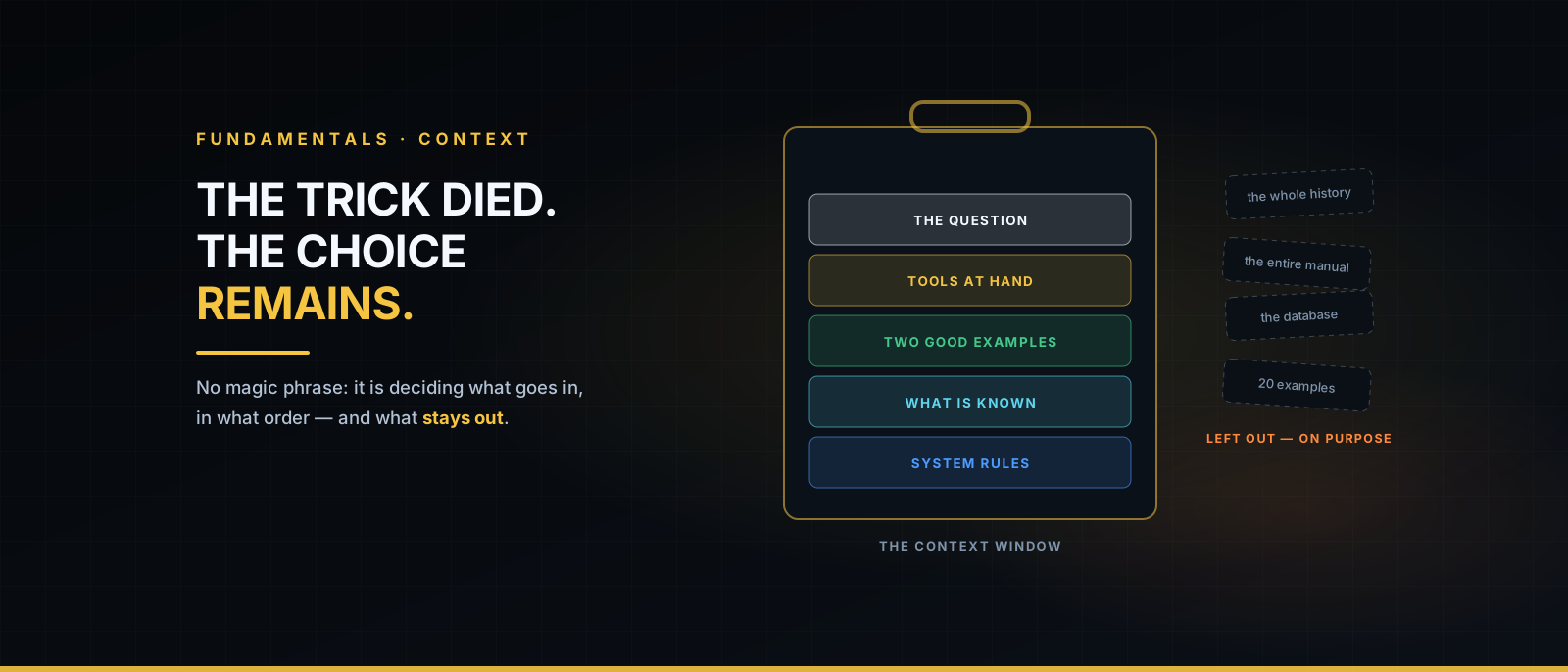
- A context budget. What goes into the window is a design decision: what is fixed, what is retrieved by search, what is summarised, what is discarded. Filling the window makes the result worse; attention dilutes too.
- An output contract. A structured format, validated against a schema, with a defined behaviour when it does not match.
The name this discipline earned is context engineering, and it is a far more honest description of the work: assembling the right set of information, tools and constraints so the model has a chance of getting it right.
Prompt engineering was never about the magic word. It was about removing ambiguity. Ambiguity has not gone anywhere.
The two-minute test
Before blaming the model for a bad answer, read your request and answer this: could a competent professional who does not know your company and cannot ask you anything do what you asked?
The overwhelming majority of the time the answer is no — context is missing, criteria are missing, format is missing. The model did not fail; it filled the gap with what was plausible, which is exactly what it does.
Fix the request before switching models.
Is it still worth studying?
It is, with the aim adjusted. Studying a catalogue of tricks is a waste of time. Studying how to assemble context, how to evaluate output, how to structure a task and how to design the interaction between model and tool is what separates people who make demos from people who put systems live.
The easy part of the skill became a commodity. The hard part became a profession.
Get the next articles
No spam. One message when a new article is out, with an unsubscribe link in every one.