Why programmers will not be replaced by AI (but the job already changed)
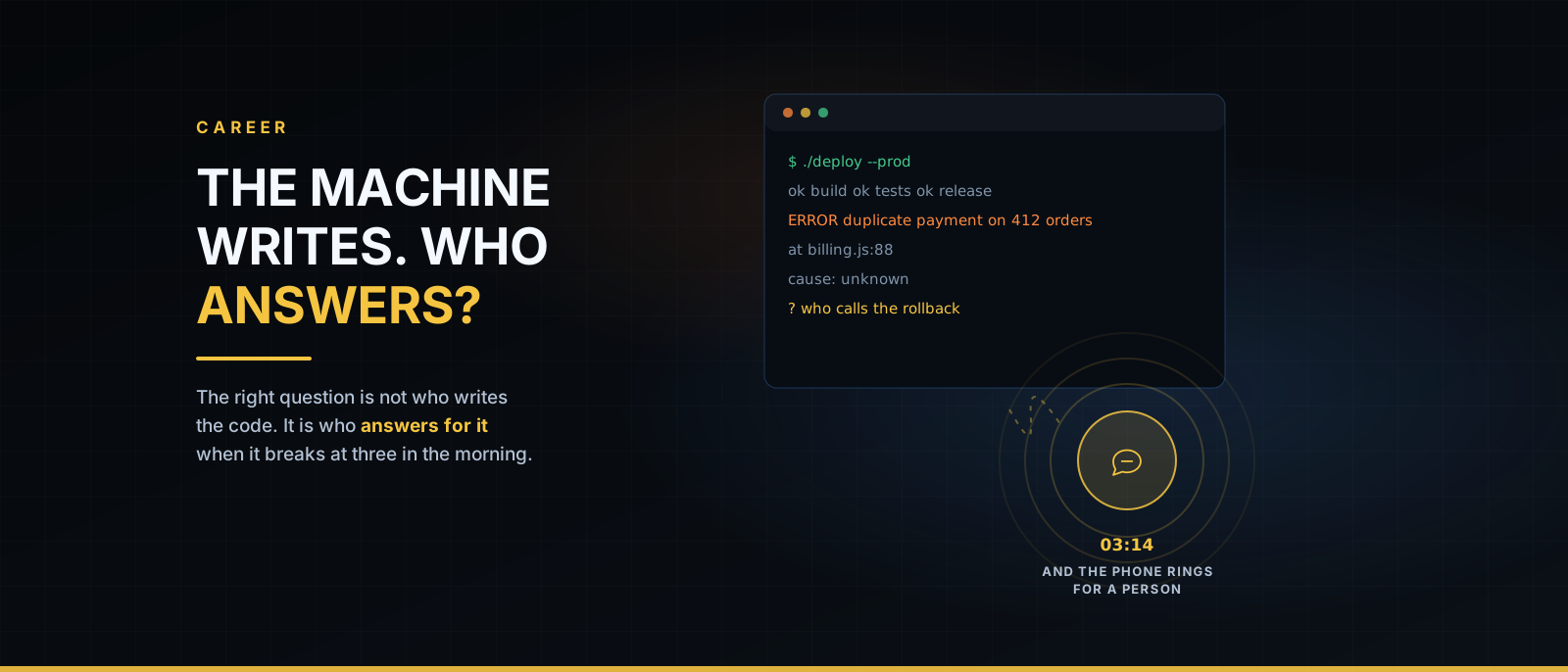
The right question is not whether AI writes better code than you. It is who answers when the code breaks at three in the morning.
The question is badly framed
"Will AI replace programmers?" is the question that sells headlines and decides nothing. It assumes that the work of programming is typing code — when typing code was always the smallest part of the job.
Run the test on your own week. Add up the hours: how much went into writing new lines, and how much went into understanding a system that already existed, negotiating scope, deciding what not to do, hunting down the cause of a strange behaviour, reviewing someone else's work? Typing is the visible tip of a job that is almost entirely decision-making under incomplete information.
AI got excellent at the visible tip. That is why it impresses so much and displaces so little.
What AI genuinely absorbed
Be honest about the size of the change, because it is large:
- The first-draft code. A function sketch, a test, an endpoint, a migration, an infrastructure script. What you would write in twenty minutes with the docs open comes out in twenty seconds.
- Translation between languages and frameworks. Learning the syntax of something new stopped being a barrier to entry.
- Reading other people's code. A decent summary of a thousand-line file, instantly.
- The friction work. Regex, formatting, boilerplate, that YAML nobody memorises.
That is an enormous slice of what used to be called "junior programmer work". Pretending otherwise would be dishonest.
What it did not absorb — and the reason is structural
What is left is not left by accident. It is left because it depends on three things a language model has no access to:
Context that is written down nowhere. The business rule that exists because a big client had a fight about it in 2021. The service nobody may restart during business hours. The architectural decision that looks dumb and is the only one that survives an audit. None of that is in the repository. It is in people's heads and in conversations.
Responsibility. When the system takes down a day of revenue, someone has to answer for it. No model assumes consequence — and while none does, there is a human role in the middle of the path. Responsibility is not a task you delegate upward; it is a bond.
Judgment about what is worth doing. AI answers the question you ask. It does not warn you that the question is wrong, that this feature should not exist, that the real problem is process and not software. Whoever decides what to build is still worth more than whoever builds it.
AI multiplied the capacity to produce code and did not touch the capacity to decide which code should exist. That imbalance is the new profession.
What actually changed
Here is the uncomfortable part, usually left out of the optimistic pieces.
The entry step got higher. The work that used to train juniors — small tasks, well defined, low risk — is exactly what AI does better and cheaper. People starting out have to get near judgment faster, with fewer miles on the odometer. That is a real problem of how we grow people, and the market has not solved it.
Reviewing got more expensive than writing. Producing a thousand lines today costs almost nothing. Making sure those thousand lines are right costs what it always did. The bottleneck moved from production to verification, and teams that have not noticed are piling up code nobody read carefully.
Value migrated to the edge of the system. The closer to the model, the more commoditised; the closer to the domain — the business rule, the company's data, the ugly integration with the legacy — the more irreplaceable.
What to do with this on Monday
None of this turns into action by itself, so let us be practical:
- Use AI for the draft and save your head for the review. If you are reading what it produced with the same attention you would give a stranger's pull request, you are using it right.
- Learn to read faster than you write. Critical code reading became the central skill of the decade.
- Move closer to the problem, not to the technology. Understanding why the company makes money is a competitive advantage no model copies from your repository.
- Build verifiable systems. Tests, types, contracts, observability. Everything that turns "looks right" into "is proven" is worth double in a world of mass-generated code.
- Take responsibility in public. The person who answers for the outcome is the last one to be let go.
The balance
Programmers will not be replaced, because the profession was never about typing. But whoever defined their professional identity by the typing will feel the floor disappear — and that part is true enough to be taken seriously.
The profession is becoming what it always claimed to be: engineering. Decision, constraint, consequence. The difference is that you can no longer hide behind the keyboard.
Get the next articles
No spam. One message when a new article is out, with an unsubscribe link in every one.