Generative AI vs. agentic AI: what is the difference?
One produces what you ask for. The other pursues a goal and decides the steps on its own. The distance between them is where all the risk and all the value live.
The difference in one sentence
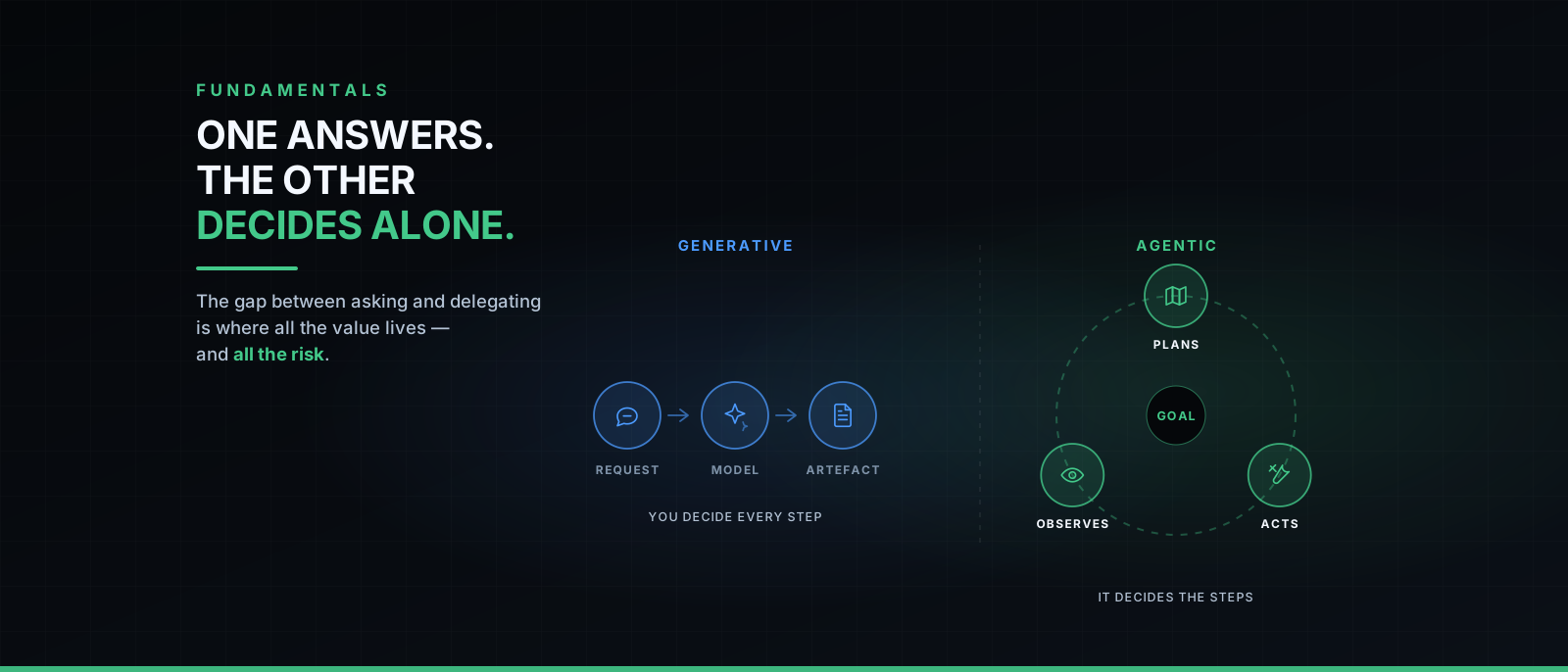
Generative AI produces an artefact when you ask for it. Agentic AI pursues a goal, deciding the steps on its own until it gets there.
It sounds like a subtle distinction. It is the difference between a calculator and an accountant.
The same request, both ways
Picture the request: "I need to know which customers stopped buying in the last ninety days and send them an email."
With generative AI, you get: a well-written SQL query, a persuasive email, and maybe a script to send it. Three excellent artefacts. Then you run the query, you review the list, you hit send. The system produced; the execution is yours.
With agentic AI, the system queries the database itself, looks at the result, notices that the last-purchase column has null values, decides how to handle them, cross-checks against the list of people who already cancelled so as not to embarrass anyone, drafts the email, and stops at the door of sending to ask for your approval — or sends it, if you authorised that.
The difference is not the quality of the text. It is who executes, and who decides along the way.
The loop
Technically, it all comes down to a loop.
Generative: input → output. One pass, predictable, with a cost you know before running it.
Agentic: goal → reasoning → action → observation → reasoning → action → ... until a stopping criterion. Unknown number of steps, variable cost, and every action touches the real world.
Four consequences come out of that loop, and none of them can be ignored:
- Unpredictable cost. One task may take ten calls or two hundred. With no step limit, you find that out on the invoice.
- Compounding error. Ninety-five per cent accuracy per step, over ten steps, lands under sixty per cent at the end. Per-step reliability is everything.
- Side effects. An executed action does not roll back. A sent email is a sent email.
- The need for a trace. When it goes wrong, someone has to reconstruct every decision. Without a structured log of each step, you do not have a system; you have an oracle.
How to tell which one you need
Ask three questions, in this order:
1. Does the task have steps that depend on the result of the previous step? If not — if it is always the same sequence — you do not need an agent. You need ordinary automation, which is cheaper, faster and more reliable. Plenty of people put a language model where an if would do.
2. Does the system need to touch the world? If it only produces text for a human to use, generative is enough. Tools are only justified when someone is going to act.
3. Is the error reversible? If it is not, either you keep a human on the approval, or you do not do it.
The useful question is not "generative or agentic?". It is "how much autonomy can this task take?". The answer is almost never "all of it".
The three levels of autonomy
In practice you can climb this in steps, and the right step depends on the cost of the error:
Copilot. The model suggests, the human executes. Minimal risk, immediate gain. It is where 80% of cases should be — and where most people are already getting real value.
Supervised agent. The system executes reversible steps by itself and stops at the irreversible ones, asking for approval. It is the best ratio of gain to risk for a company process.
Autonomous agent. Executes end to end. It only makes sense in a closed domain, with reversible actions, a limited budget and full observability. People who jump straight here usually come back down a step after a scare.
What changes in your work
If you build software: an agent is not a feature, it is a subsystem. You will need a queue, idempotency, a spending limit, retry with backoff, and a plan for when it does not converge. The old disciplines of distributed systems are back in force, with a non-deterministic node in the middle.
If you buy software: ask the vendor how many steps the agent may take, what it does on its own, where it stops, and how you audit it afterwards. A vendor who cannot answer that clearly is selling a demo.
If you only use it: notice which of the two modes you are in. Pasting a chat answer into an email is generative. Authorising an extension to act inside your browser is agentic — and it deserves a different level of attention.
Get the next articles
No spam. One message when a new article is out, with an unsubscribe link in every one.