The future of developers: less code, more architecture
When writing gets cheap, deciding gets expensive. The centre of gravity of the profession is moving from the editor to the decision.
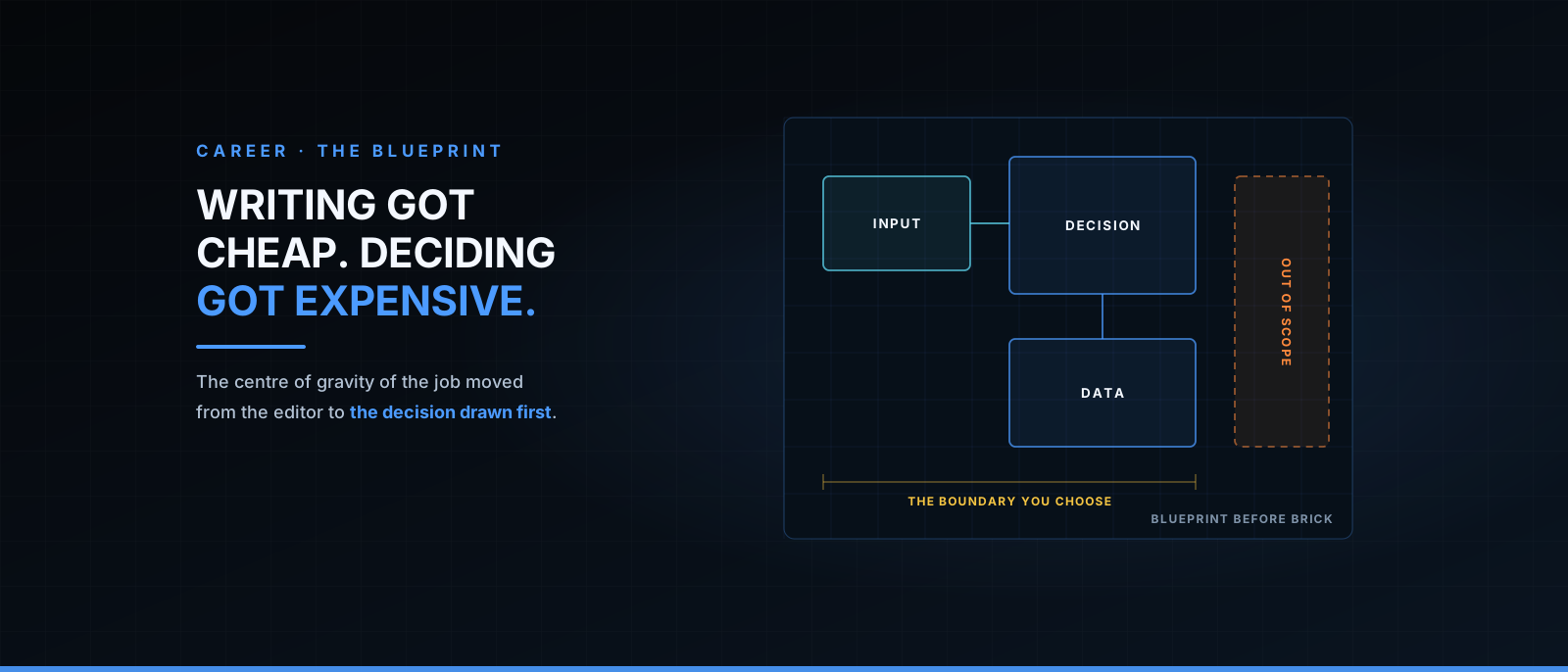
The economics flipped sides
For fifty years, writing code was the expensive part of software. Everything in the profession organised itself around that: languages to write less, frameworks to avoid repeating yourself, libraries to avoid rewriting, estimates measured in how much code was left.
That premise fell. Producing correct, idiomatic code became cheap and fast. And when the cost of one step collapses, the bottleneck moves to the next one.
The next one is deciding whether that code should exist and whether it is right.
What gets expensive when writing gets cheap
Verifying. Reading a thousand lines carefully costs what it always did. Teams that accelerated production without accelerating review are accumulating invisible debt — code that passed because it looked right.
Integrating. A system that works alone and a system that lives alongside seven others are different things. Contracts between services, versioning, backward compatibility, what to do when the other side goes down: AI decides none of that for you, because it depends on agreements between teams.
Operating. Infrastructure cost, latency, observability, a rollback plan. Mass-generated code tends to be technically correct and operationally naive — it works, but nobody thought about what it costs to run a thousand times a minute.
Choosing what not to do. The constraint was always delivery capacity. With that constraint loosened, what is left is the discipline of saying no — and it is scarce.
Architecture is not a diagram
When I say the work migrates to architecture, I am not talking about drawing boxes, nor about a job title with "architect" in it. I am talking about four concrete activities:
Defining boundaries. What a module is, what it exposes, what it hides, who may call whom. In a world of generated code, a good boundary is what keeps the mess from spreading — and what gives the agent a piece small enough to work on safely.
Choosing constraint over possibility. Strong typing, validated schemas, versioned migrations, contract tests. Every constraint you impose is an entire class of error the generated code cannot commit. That moved from "good practice" to "safety infrastructure".
Designing for verification. If a component's output can only be judged by a human reading it, it does not scale. If it can be checked by a test, a type, an invariant or a monitor, it scales. Designing verifiable systems became the central skill.
Deciding the cost. Where it pays to spend, where it pays to simplify, what can afford to be done badly on purpose. Economic judgment applied to software.
The senior developer of 2030 will read far more than they write, and what they write will mostly be constraint: contracts, tests, types, policies.
What the day looks like
You can already see the shape in teams that adopted AI seriously:
- Less time in the editor, more time in review. The proportion inverts, and reviewing stops being an end-of-day chore to become the main activity.
- Smaller pull requests. Because the bottleneck is reading, not writing. Whoever sends a giant AI-generated change is transferring their own cost to the reviewer.
- Tests and types as specification. You describe the constraint; the implementation is generated and verified against it.
- More decision records. Why we did it this way, what we considered, what we rejected. It is the context neither the model nor the new colleague has any other way of getting.
What to study now
If the bet is right, the biggest return is in these five:
- Domain modelling. Translating business into structure. The most durable skill on the list.
- Distributed systems. Partial failure, idempotency, consistency, queues. Agents brought those problems back into ordinary applications.
- Testing and verification. Property-based testing, contract testing, expressive types. Everything that turns "looks right" into "is proven".
- Operations. Observability, cost, performance. The part AI covers least and that hurts most.
- Writing. Decision records and specifications. Your interface with humans and with machines is now the same one.
Notice what is missing: no framework, no specific language. Not because they do not matter, but because those five still hold when the framework of the day is retired — and the framework of the day is always retired.
Get the next articles
No spam. One message when a new article is out, with an unsubscribe link in every one.