The 10 skills that stay valuable even when AI writes better code than humans
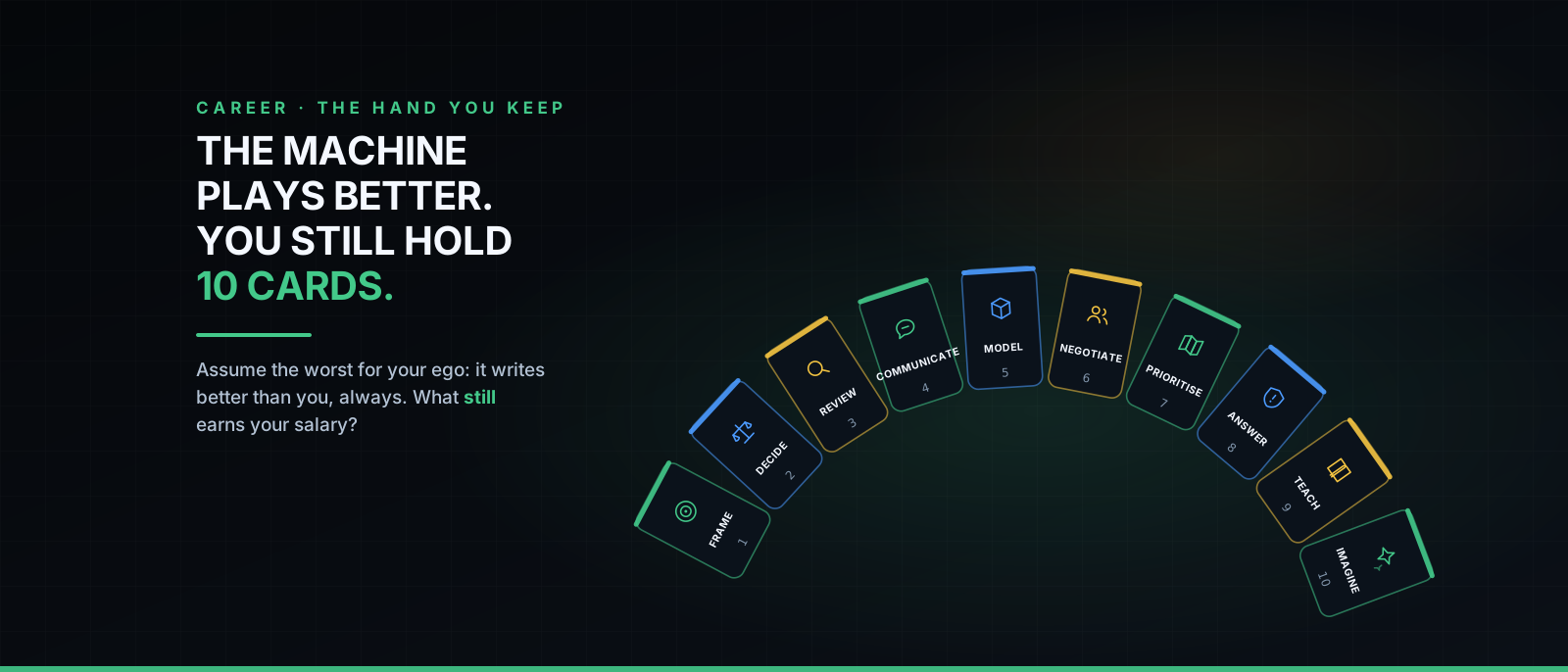
Assume the worst case for your ego: the machine writes better code than you, always. What still earns your salary?
The exercise
Let us do the uncomfortable exercise: assume AI writes better code than you. Always. Faster, with fewer bugs, in any language.
This is not a prediction — it is a stress test for your career. If the answer to "what is left?" is "nothing", you have a problem today, regardless of what AI does tomorrow. If a lot is left, you have just found where to invest your study time.
A lot is left. Ten items, in the order I would bet on them.
1. Reading code better than writing it
When producing is cheap and verifying stays expensive, the bottleneck is reading. The valuable skill is glancing at two hundred lines and spotting the one where the edge condition is wrong.
You train that the old way: by reviewing a lot of code, mostly from people better than you.
2. Modelling the domain
Translating "how the business works" into entities, states and rules. A language model does not know that, in this company, a cancelled order still generates commission. It will write beautiful code on top of a wrong model — and beautiful code on top of a wrong model is the most expensive defect there is.
3. Framing the problem
AI answers what you ask. Whoever can turn "the customer is complaining" into a precise technical question, with explicit constraints and a success criterion, extracts ten times more from the same model. That skill was never not rare — it just became visible.
4. Judgment about risk
Knowing the difference between "this breaks and we fix it tomorrow" and "this breaks and it becomes news". Dosing how much testing, how much redundancy, how much process each thing deserves. There is no generic answer: it depends on what is at stake, and the person who knows what is at stake is you.
5. Debugging a system, not a snippet
Finding a bug in a function is a task for a model. Discovering that Tuesday's slowness comes from an index the data team altered, combined with a cache with a badly chosen TTL, is work for someone who knows how to form a hypothesis, isolate a variable and read evidence. The scientific method applied to software.
6. Architecture as constraint management
Good architecture is not a pretty diagram: it is choosing which constraints you accept today so you are not trapped tomorrow. Cost, deadline, team size, regulation, ability to hire. Deciding under constraint is human territory, because the constraints are not always said out loud.
7. Written communication
A decision record, a postmortem, a proposal, an instruction for your own agent. In a world where text became the interface for machines and for people, writing precisely went from "nice differentiator" to primary work tool.
8. Calibrated scepticism
Neither swallowing everything the model says, nor distrusting everything to the point of redoing it by hand. The sweet spot is knowing where AI errs: on dates, on numbers, on an API that changed recently, on anything that requires internal context from your company. Calibrated scepticism is accumulated experience — and that is why it takes time to form.
9. Getting things live
Deploys, migrations, feature flags, rollbacks, maintenance windows, communicating with the customer. The distance between "works on my machine" and "is in production without waking anyone up" is still engineering work with a name, a surname and an on-call phone number.
10. Responsibility
The last one and the most underestimated. Someone signs off. Someone wakes up at three in the morning. Someone explains to the board what happened.
AI takes on tasks. It does not take on consequences. While that stays true, there is a human role in the middle of the path — and it keeps the best-paid part.
The pattern behind the list
Notice what those ten things have in common: none of them is about syntax, framework or language. All of them are about judgment applied to context.
That is why the practical answer is not "learn the next AI tool". It is to gain altitude: get closer to the problem, to the risk and to the decision. Tools change every six months; judgment compounds.
Get the next articles
No spam. One message when a new article is out, with an unsubscribe link in every one.