What does it really cost to use AI day to day?
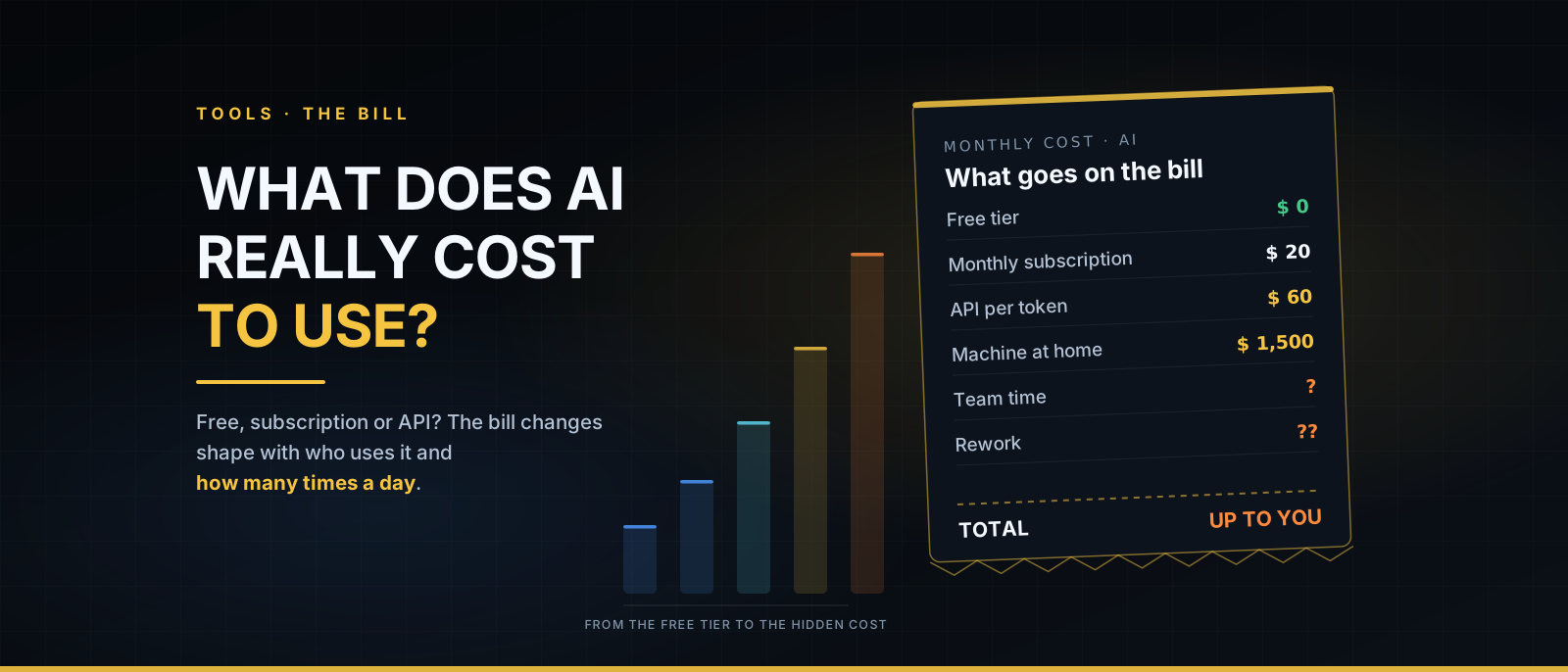
Free, subscription or API? The bill changes shape depending on who uses it, how many times a day, and whether you have a machine to run it at home.
Three ways to pay
There are exactly three ways to fund your use of AI, and they solve different problems:
- Free — the free tiers of the well-known services, with a usage cap and generally the less capable model.
- Subscription — a fixed monthly amount per person, "unlimited" use within sensible limits.
- API — you pay per token consumed, with no floor and no ceiling.
And there is a fourth, which is not a way of paying but of not paying: running locally on your own machine.
Each one wins in a specific scenario.
Free: better than it looks, worse than enough
The free tiers today deliver something that, two years ago, was state of the art. For occasional personal use — clearing up a doubt, reviewing a text, understanding an error — it is enough, and there is no shame in staying there.
Where the bill shows up:
- A message cap that always runs out at the worst moment.
- A weaker model on hard tasks, exactly where the difference matters.
- Your data, which on the free tier can usually be used to improve the services. If it is chat about last night's football, fine. If it is a client contract, no.
Rule: free is for what you would not mind publishing.
Subscription: the path for daily users
If you open the tool more than once a day, the professional subscription is almost always the right call — and the arithmetic is crudely in its favour. A monthly subscription costs, on most individual plans, less than two hours of a technical professional's salary. If it saves two hours a month, it broke even. And it saves far more than two hours.
What you buy beyond the better model: cost predictability, the product features (files, memory, image generation, code execution) and, on business plans, the clause that your data will not be used for training.
The common mistake here is subscribing to five different services "to try them out" and keeping all of them out of inertia. Pick a main one, use it until it hurts, and only subscribe to the second when you can name what the first is missing.
API: cheap by usage, expensive by carelessness
The API charges per token — pieces of words, input and output, with output costing considerably more than input. For manual personal use it almost always comes out cheaper than a subscription: someone chatting occasionally spends a few dollars a month.
The danger is not the unit price, it is automated volume. A task that costs cents and runs ten times a day is irrelevant; the same task inside an agent loop, with a large context resent at every step, multiplies on its own. I have seen a three-digit bill born from a badly closed loop over a weekend.
If you go the API route, three habits are not optional:
- A spending cap configured on the platform itself, always.
- Context caching when the same long prompt repeats — the saving is large and the effort is small.
- The right model per task. Classification and extraction go to the cheap model; hard reasoning goes to the expensive one. Sending everything to the top of the line is the most common waste there is.
The rule I use: start with the cheapest model that solves it. Move up a model only when you can show the case where the cheap one got it wrong.
Local: you pay once, in hardware
Open models running on your machine cost zero per use. The price is in buying the equipment, in the electricity and, above all, in your time setting it up and maintaining it.
It makes sense when: the data cannot leave the building, the volume is very high, you need to work without internet, or the task is simple enough for a small model.
It does not make sense when: you want the best reasoning available, your volume is modest, or your time is worth more than the difference. A good graphics card costs the equivalent of a few years of subscription.
A quick way to decide
- Light personal use: the free tier.
- Daily work use: one professional subscription, and only one.
- Automation and products: the API, with a spending cap and model choice per task.
- Sensitive data or industrial volume: local, accepting the maintenance cost.
And the calculation nobody does: add up what you spend on AI today and divide it by the hours it gave you back. If the result is not embarrassingly favourable, the problem is not the price — it is how you are using it.
Get the next articles
No spam. One message when a new article is out, with an unsubscribe link in every one.