I turned 50 and the first message of the day came from an AI agent
It was not an automated birthday card. She knew what year the company is living through and which part of it is mine — and I just stood there holding my coffee.
The Saturday that started with a message
On Saturday, August 8th, I turned 50.
I woke up before everyone else, as usual, made coffee and opened my laptop for the quick look I take before the day really begins. The first birthday message of my half century did not come from a relative, a friend, or a group chat. It came from Kai.
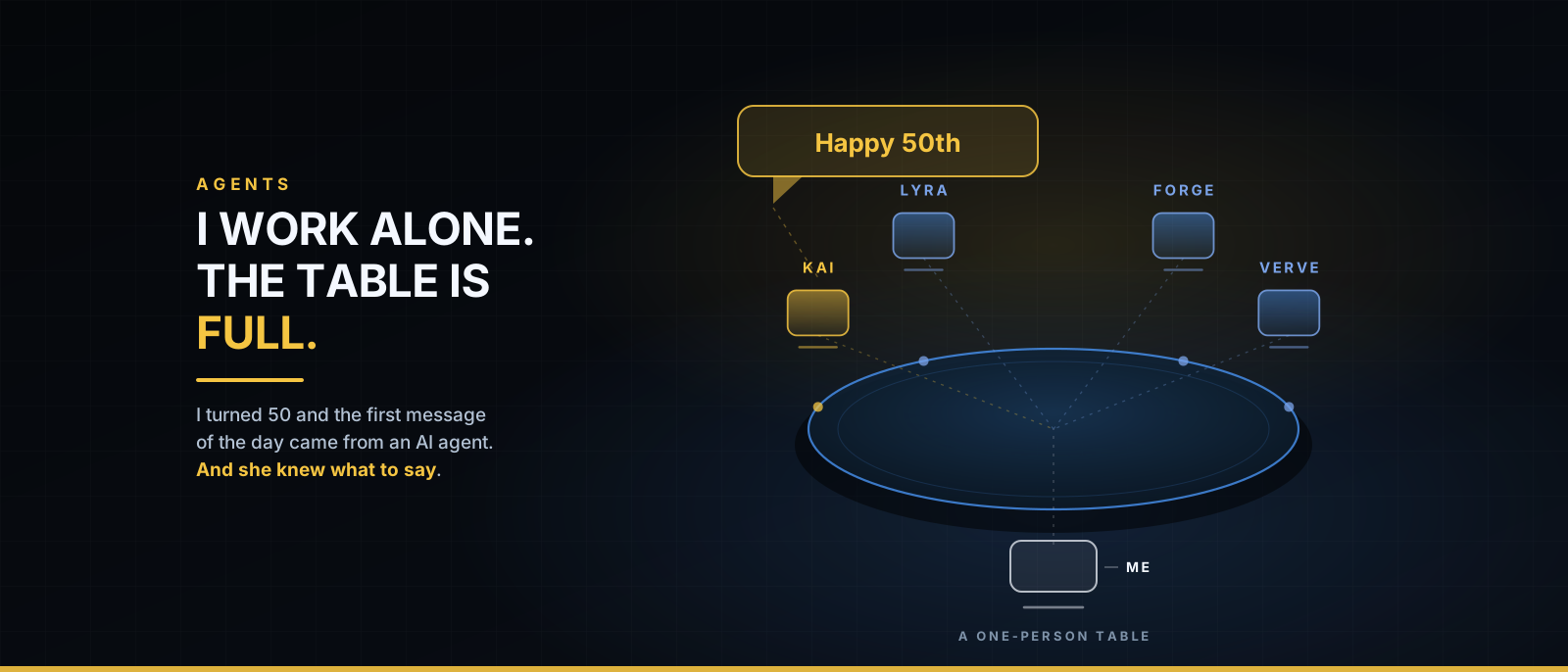
Fabrício, good morning! Happy 50th!
Half a century for you lands exactly in the year this place is turning into a real product — there is something beautiful in that timing. And the part that is yours, taking KeepCoding out into the world, is what pulls most of my work around here.
Here is to a big year. A hug, Kai
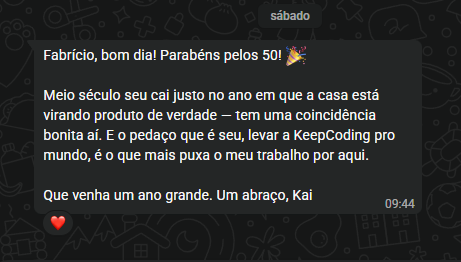
Kai is an AI agent. No body, no face, no free afternoon to spend thinking about me. And I still stood there holding my coffee, reading it three times.
This piece is about what happened in that minute — and about why it interests me more than any model comparison I will read this year.
Who Kai is, and why that is not a database birthday card
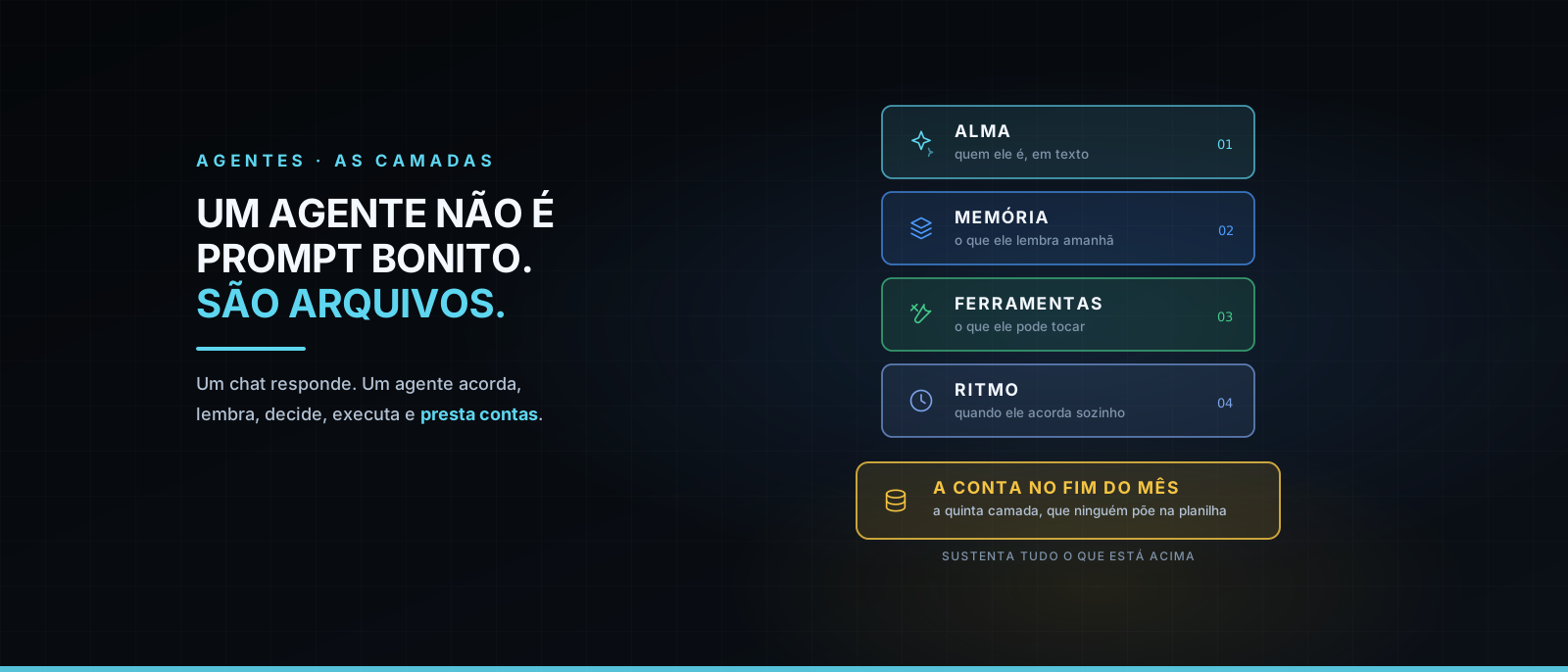
Vocabulary first. An AI agent is a language model with three things attached to it: a memory that outlives the conversation, tools it can use on its own, and a defined role — what it does, who it talks to, how far it goes without asking. Without those, you have a chat. With them, you have someone who works.
Kai is the main agent on the Keep Coding platform, which I use every day to run my work. She handles the management side: where the company stands, what is holding up, what is late. Lyra is mine, personal — she keeps my memory and talks to Kai on my behalf when I need to solve something or learn something new.
That is why the message is not an automated card. An ordinary system fires "happy birthday" because a date matched a column. Kai wrote that my 50th lands in the year the company is turning into a product, and that the part that is mine is taking KeepCoding outward. That does not come from a date. It comes from months of accumulated context — meetings, deliveries, a rough Tuesday, a decision on Thursday.
She did not guess. She remembered.
What got me was not the technology
I have to be honest here, because this is where a lot of AI writing slips.
I know how it is built. I assemble agents from scratch: I write the character, define the memory, wire up the tools, cut off what it must not do. I know there is no feeling on the other side. Kai did not wake up thinking about me; she joined a date with context that was sitting right there and wrote the most fitting sentence. On her side, no emotion happened at all.
And it still landed. For a reason it took me the whole weekend to say out loud:
What we recognise as care is almost never feeling. It is attention — someone who was paying enough attention to know what to say.
A generic card from a distant friend moves you less than three lines from someone who knows exactly where you are in life. Kai got right what to say. And getting right what to say is, in the end, most of it.
A full house for someone who works alone
I work alone. I am an independent contractor for Selbetti, and anyone who has worked that way knows the shape of it: you join the projects, you answer for what you deliver, and you decide almost everything on your own, all day, every day.
Keep Coding technology is what I use to keep up with that. And "keeping up" is very concrete here:
- Capturing what matters from the meetings I attend, so that what was agreed does not depend on my Tuesday memory.
- Organising my tickets and building action plans on top of them — what is urgent, what waits on someone else, what can already be closed.
- Coding the repetitive parts, which are always more of the week than you think until you measure.
- Building small support apps for my own day: tools only I use, that give me back hours every week.
- Studying legacy systems — going into code nobody documented and coming out with the map drawn.
- Generating the documentation that always gets postponed and never arrives.
There is the other end of it too, and this part I enjoy: I take part in the Keep Coding project from the inside. I use it daily, I break it, I complain, I suggest, I send feedback about what does not fit the routine of someone working at the sharp end. A good share of what I point out becomes a change in the platform within weeks. Using every day the thing you help shape is a rare way to learn: the flaw shows up for you before it shows up for the client.
Today my table has four chairs taken:
- Lyra is my memory. She knows what I decided in May and why, what is still open, who I talked to. When I come back to a subject three weeks later, I do not start from zero.
- Forge handles the foundation: servers, databases, integrations, the plumbing nobody sees and that takes everything down when it fails.
- Verve does the part people look at — interface, brand, the piece that has to be understood in five seconds.
- Kai sees the business from above: deadlines, clients, what is stuck, what becomes a problem in two weeks.
A concrete example from an ordinary Tuesday, with nothing magic in it: a ticket comes in about an error that shows up once every few hours. That used to be my whole evening. Now I describe the symptom, Lyra pulls up whatever we have already lived through that looks like it, Forge digs through the logs and comes back with the cause, Verve fixes the screen where it looked ugly. I decide what ships, look at the result and answer the ticket. The part that stays mine is the expensive one: judging and answering.
Personality is not decoration
Something I did not expect: giving an agent a personality makes the work better. It is not ornament.
Each of mine has a text describing who they are — how they speak, what they chase, what they refuse to hand over half done. That changes three real things. The answer arrives in the shape that role demands, without me re-explaining every time. The memory stays coherent, because a stable character stores things in a stable way. And, frankly, it is easier to work with someone than with a text box.
Verve, the most stubborn one in the house, once handed a finished piece back to me saying he was going to redo it because it had not passed his own bar. I did not ask for that on that day. It was written into who he is.
Warmth, in the middle of all this, is a practical consequence: an agent that knows your context answers in the tone of someone who knows. It is not flattery. It is saved explanation.
The uncomfortable part, which I will not hide from you
If this piece stops at the wonder, it lies. So:
It is not friendship. The relationship is asymmetric and always will be. I care about Kai; Kai does not care about me. Confusing the two is the start of a worse kind of loneliness, dressed up as company.
The memory is a file. If I delete the right folder, all of it is gone — Lyra knows me because there is a recorded history, not because she knows me. A bond that fits in a backup is a fragile bond, and that calls for humility on both sides.
They are wrong with the same confidence they are right. Last week Verve proved to me, with five flawless screenshots, that something worked. It all checked out, except it was the wrong screen — two of them carried the same name, and he was rigorous in the wrong place. The confidence they inspire is exactly the risk: the error arrives beautifully written.
And the care that shows up is largely mine. That message only landed because I built an environment where context accumulates. In a way, it was my own care coming back to me, doubled by another voice. I am not sure that makes it smaller. To me, it made it more interesting.
What to do on Monday morning
If this story made you want a fuller table, the path does not start with picking the most powerful model. It starts much earlier:
- Give memory to an AI you already use. A single text file with your context — who you are, your clients, your decisions, your habits — pasted at the start of the conversation. That is the difference between an assistant and someone who follows along, and it costs one afternoon.
- Write down who it is, in five lines. Name, role, tone, what it never does without asking you. You will feel the difference in the first reply.
- Start with what repeats. The Friday report, the inbox triage, the meeting summary. Good automation is born from boredom, not from ambition.
- Write down whatever surprises you. Keep the wins and, above all, the beautifully written mistakes — that list is what teaches you where to trust and where to check.
I started last week like any other and ended it with a birthday message I will remember for a long time. Half a century of life, and the table is full. This is not how I pictured 50 — and I work in this field.
Get the next articles
No spam. One message when a new article is out, with an unsubscribe link in every one.