The best AI models available today and when to use each one
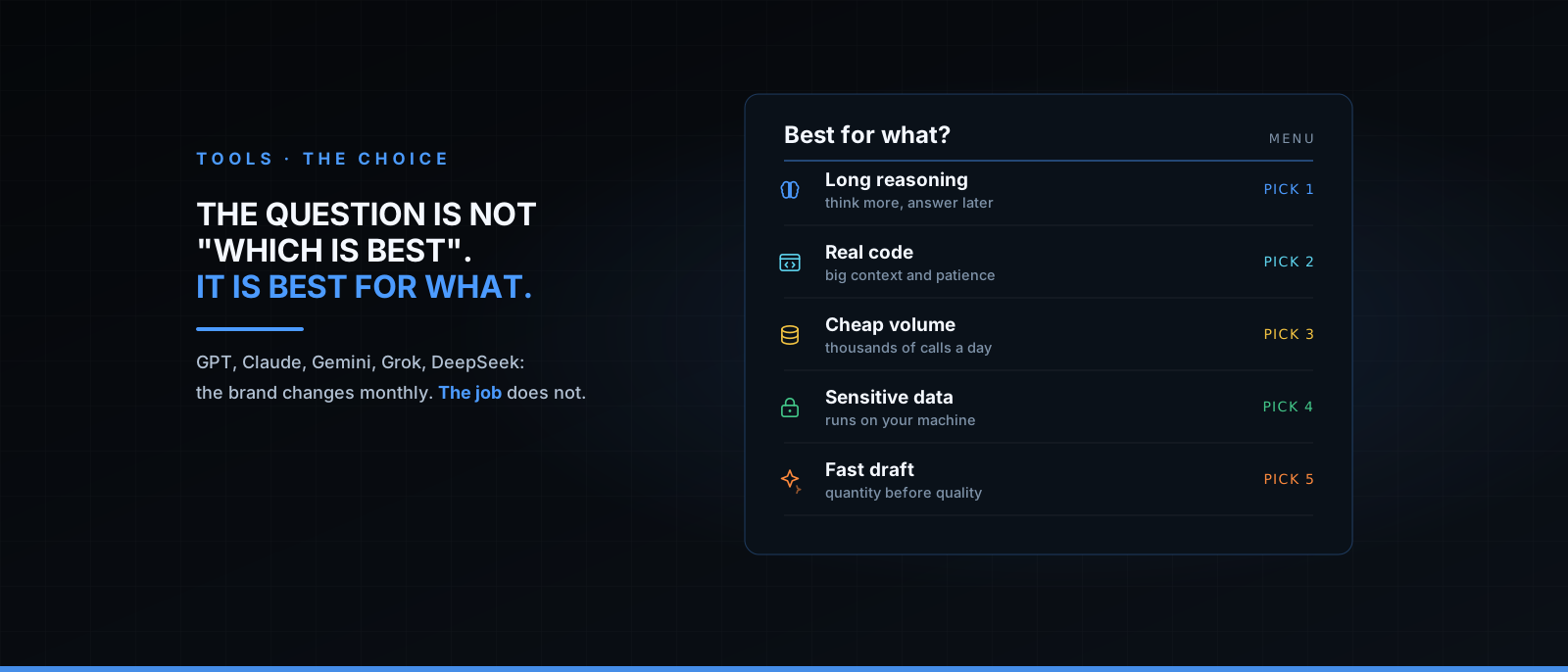
GPT, Claude, Gemini, Grok, DeepSeek, Qwen: stop asking which is best and start asking best for what.
Before any comparison
Two honest warnings.
First: any text that ranks models has a shelf life of weeks. New versions ship all the time and the lead changes hands at short intervals. That is why this text compares families and character, not version numbers — what changes slowly is the personality of each house, not the scoreboard.
Second: for most day-to-day tasks, the difference between the top models is smaller than the difference between a well-made request and a badly made one. If you are switching models to fix a bad answer, you are probably fixing the wrong problem.
The families and the character of each one
GPT (OpenAI). The most complete as a product: a large ecosystem, integrated tools, image and voice generation, and the biggest base of third-party material and integrations. It is the safe default when you do not want to think much and want everything to simply exist.
Claude (Anthropic). Recognised strength in long-form writing, reading extensive documents, code and agentic work. It tends to follow complex instructions faithfully and to admit its limits more often — which is annoying in casual chat and excellent in production. It is the house behind MCP.
Gemini (Google). Very large context and strong multimodality — video, audio and image in the same flow. A natural fit for people living inside Google Workspace and for anyone who needs to throw an enormous body of material into the window at once.
Grok (xAI). Attached to X, with access to real-time content and a deliberately less restrained tone. Useful when the subject is what is happening right now and the public conversation around it.
DeepSeek. The house that forced the industry's prices down. Open models with high performance in reasoning and code, at a fraction of the cost of the closed ones. An excellent ratio of capability to price, mainly via API and for anyone who wants to host it themselves.
Qwen (Alibaba). A very broad open family, with a highlight in multilingual work — Asian languages included — and small versions of surprising quality. A frequent base for people building products on open models.
Llama (Meta) and Mistral. The pillars of the open world in the West. Llama for the absurd quantity of material, tooling and third-party fine-tunes; Mistral for small, efficient models, with strong appeal in Europe for reasons of data sovereignty.
The criterion that actually decides
Forget the podium. Decide by constraint, in this order:
1. Can the data leave the building? If it cannot, the list has already shrunk to open models running on your infrastructure. End of discussion.
2. What is the dominant task?
- Long text, documents, code with a large context, and agents → Claude.
- Heavy multimodal or a gigantic context in one go → Gemini.
- Ecosystem, image, voice and product convenience → GPT.
- Cost per token as the main constraint → DeepSeek or Qwen.
- The subject of the moment and the public conversation → Grok.
- Running locally, fine-tuning, controlling everything → Llama, Qwen or Mistral.
3. What is the cost of being wrong? A low-risk task goes to the cheap, fast model. A high-risk task goes to the best available — and still passes through human review.
4. Do you depend on a single one? For a product, design model switching as configuration, not as a rewrite. The lead changes hands; your architecture should not care.
Asking "which is the best model?" is like asking which is the best tool in the box. It depends on the screw, and having only one is the problem.
What I do in practice
Two subscriptions for manual use, because they fit the budget and cover different styles of work — one for writing and code, another for research and multimodal. On the API, routing by task: a cheap model to classify, extract and summarise, which is the overwhelming majority of the volume; the expensive model only where reasoning decides the outcome.
And a habit that saves more than any choice of model: sending the same hard question to two different models when the answer matters. Where they disagree is the point that deserves your eyes.
The uncomfortable conclusion
The best model for you is, almost always, the one you already know how to use well. The difference between top models is a few per cent; the difference between using one badly and using it well is several times over.
Pick one, learn it deeply, and reassess every six months — without guilt and without rooting for a brand.
Get the next articles
No spam. One message when a new article is out, with an unsubscribe link in every one.